
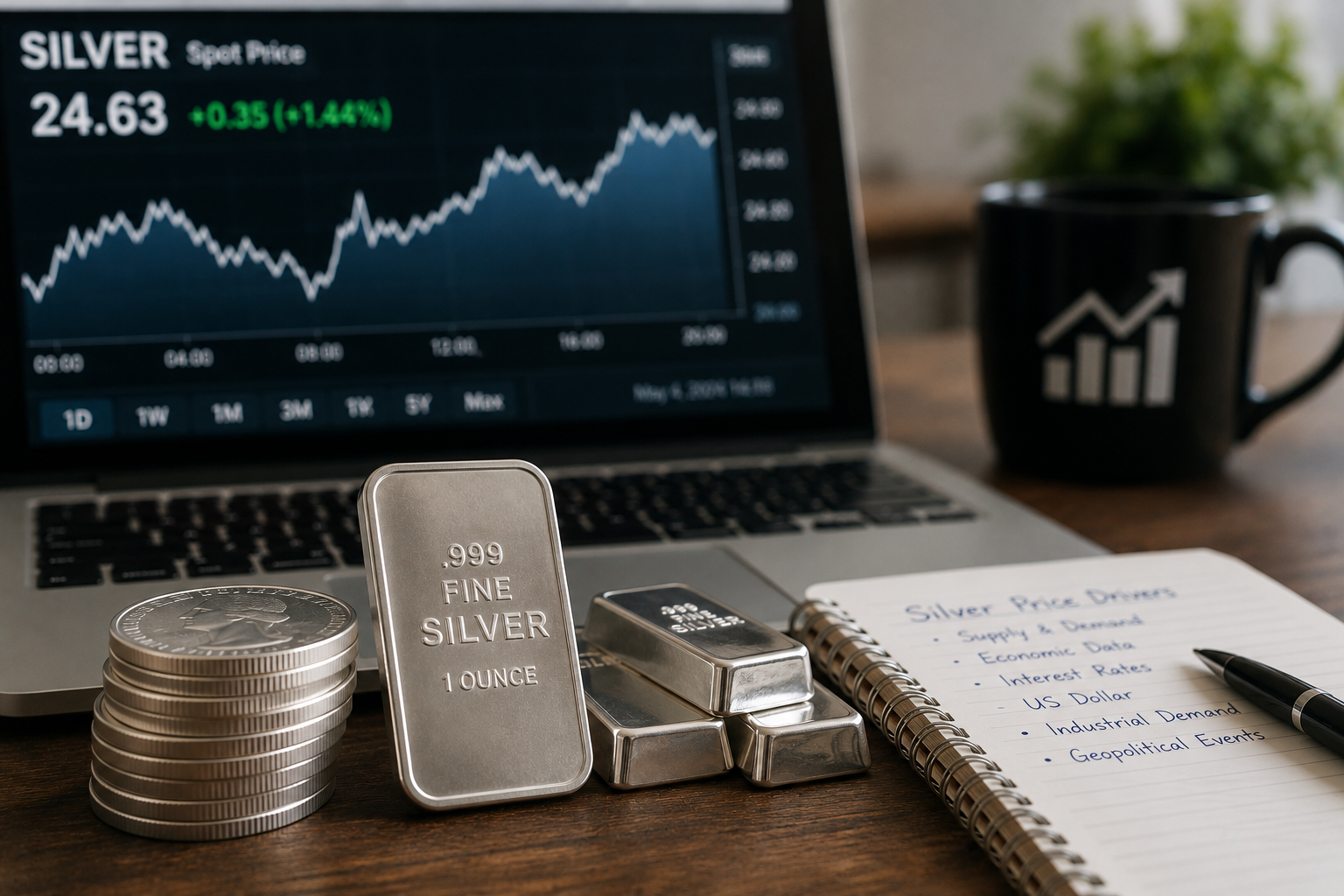
Anyone who follows precious metals will quickly notice that the current spot price of silver rarely stays the same for long. Unlike many everyday products with fixed retail prices, silver is traded continuously on global financial markets, meaning its value can rise or fall throughout the day as buyers and sellers react to changing economic conditions. For investors, collectors and anyone considering purchasing physical silver, understanding why these price movements occur provides useful insight into how the market operates and why short-term fluctuations are a normal part of precious metal investing.
The spot price represents the market price for silver available for immediate delivery. It acts as the benchmark from which dealers calculate the selling prices of silver coins, bars and bullion products. While physical products often include additional costs such as manufacturing, distribution and dealer premiums, the spot price remains the foundation upon which most silver pricing is based.
Because the spot price reflects real-time market activity, it responds continuously to new information.
One of the primary reasons silver prices move throughout the day is simple supply and demand.
Every second that financial markets are open, investors, institutions, manufacturers and traders are buying and selling silver. When demand exceeds available supply, prices generally move upwards. When selling pressure outweighs buying interest, prices may decline.
These movements often occur in very small increments, but they can accumulate significantly over the course of a trading session.
Global financial markets also contribute to continuous price changes.
Silver is traded around the world rather than within a single country. As markets open and close across Asia, Europe and North America, new participants enter the market, bringing fresh buying and selling activity.
This near-continuous global trading means the silver market is constantly reacting to economic developments occurring in different parts of the world.
Economic data releases frequently influence investor behaviour.
Announcements relating to inflation, employment figures, economic growth, manufacturing output and central bank policy can all affect expectations about future economic conditions.
If investors believe economic uncertainty is increasing, some may increase their exposure to precious metals. Conversely, positive economic news may encourage investment in other asset classes instead.
The market often reacts within minutes of important announcements, causing noticeable movements in the spot price.
Interest rates are another significant influence.
Silver does not generate interest or dividend income, meaning its attractiveness can change depending on returns available elsewhere.
When interest rates rise, investments such as savings accounts and government bonds may become more appealing because they provide higher income.
Lower interest rates can have the opposite effect by reducing the opportunity cost of holding precious metals.
As investors adjust their portfolios in response to changing monetary policy, silver prices often respond accordingly.
Currency markets also play an important role.
Silver is generally priced internationally in US dollars. Changes in the value of the dollar therefore affect purchasing power for buyers using other currencies.
A weaker dollar often makes silver more affordable internationally, potentially increasing demand. A stronger dollar may reduce international buying interest because silver becomes relatively more expensive for overseas investors.
This relationship means that currency movements frequently influence silver prices even when underlying supply and demand remain relatively stable.
Industrial demand distinguishes silver from many other investment assets.
While gold is primarily purchased for jewellery, investment and central bank reserves, silver has extensive industrial applications.
It is used in electronics, solar panels, medical equipment, automotive manufacturing, electrical components and numerous other industries.
Expectations about industrial production can therefore influence silver prices throughout the trading day.
Announcements relating to manufacturing activity, technological development or industrial demand may all contribute to changing market sentiment.
Geopolitical events can also trigger rapid market reactions.
Political instability, international conflicts, trade disputes or unexpected global events often increase uncertainty within financial markets.
During periods of heightened uncertainty, some investors seek assets they believe may help diversify risk, including precious metals.
Although no asset is immune to market fluctuations, changing investor sentiment during uncertain periods can produce noticeable movements in silver prices.
Speculative trading also contributes to short-term volatility.
Not everyone participating in the silver market intends to purchase or sell physical bullion.
Many professional traders buy and sell silver contracts based on short-term market expectations, attempting to profit from relatively small price movements.
While these transactions may increase day-to-day volatility, they also contribute to market liquidity by ensuring active participation throughout the trading day.
Physical supply changes tend to influence prices more gradually.
Mining production, recycling activity and refining capacity all affect the amount of silver available globally.
However, increasing mining output or developing new production facilities takes considerable time, meaning supply adjustments usually occur over months or years rather than hours or days.
For this reason, short-term price movements are often driven more by changing demand and investor expectations than by immediate changes in physical supply.
Retail buyers sometimes misunderstand the relationship between spot prices and dealer prices.
The spot price reflects wholesale market activity rather than the final amount paid for physical products.
Silver coins and bars typically include additional costs covering refining, minting, transportation, storage and retailer margins.
As a result, physical silver almost always sells above the current spot price.
Similarly, individuals selling silver back to dealers should expect offers that reflect market conditions, product type and dealer operating costs rather than matching the published spot price exactly.
One common mistake made by new investors is becoming overly concerned about small intraday price movements.
Silver prices naturally fluctuate throughout every trading session, and attempting to buy or sell based on minute-by-minute changes can become both stressful and impractical.
Many experienced investors instead focus on longer-term objectives, recognising that daily volatility is simply part of how global commodity markets operate.
Regular purchasing strategies may also help reduce the impact of short-term fluctuations by spreading purchases across different market conditions.
Understanding why prices move can encourage more informed decision-making while reducing emotional reactions to temporary market swings.
The current spot price of silver changes throughout the trading day because it reflects the combined actions of investors, manufacturers, financial institutions and traders responding to constantly evolving economic conditions. Global trading activity, interest rates, inflation expectations, currency movements, industrial demand and geopolitical developments all influence market sentiment, causing prices to adjust continuously. While these fluctuations may appear unpredictable in the short term, they represent the normal functioning of an active international market. For anyone interested in investing in silver, recognising how and why spot prices move provides valuable context that supports more confident and informed purchasing decisions.